Showing posts with label moral formation. Show all posts

Monday, January 28, 2013

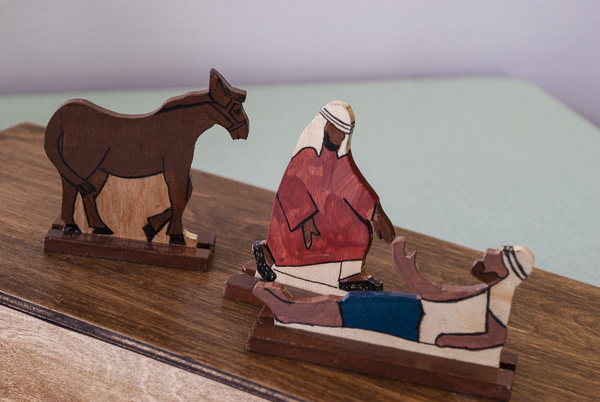
The Good Samaritan


The Sunday before last we had a very small group, and I presented the Good Samaritan material to a few children for the first time. The children were really engaged with the work and made some wonderful observations. I've been enjoying one reflection ever since.

We've talked a lot about the History of the Kingdom of God, and the children know about parousia - the time yet to be when Christ will come again and God will be all in all. I was thinking of this when I wondered with the children what it would be like if everyone was like the Good Samaritan. In a joyful voice, one child said, "it would be the Earth of God - all in all!"

I just love that!

Thursday, December 8, 2011

The Fettuccia


How can we begin to grasp the History of the Kingdom of God? In November in the True Vine Atrium we gathered together for a work called the Fettuccia which tells us about three great moments in God's Kingdom - creation, redemption, and parousia. The work represents billions of years with a long thin grosgrain ribbon. Each ridge on the ribbon represents about 1000 years.

As we unroll the ribbon we ponder creation - the great and loving act of God preparing the earth, plants, animals, and people. We remember redemption - God sending Jesus to live among us, and his life of compassion, his death and his resurrection. And finally we consider parousia - that great moment still to come when Christ will return and God will be all in all.

In our Church, this ribbon stretches from one end of the building to the other - travelling from the Good Shepherd Room, through the center staircase and front hall, down the length of the center aisle of the Church and ending at the altar. This is an impressionistic lesson which allows us to "see" all those years - we peer from one end of the ribbon to the other and walk its length time and time again to identify moments in the History of the Kingdom of God.

This material is very satisfying to the children, and it creates a frame of reference for so many of the works we have done and will do in the future in the atrium. It brings together science and theology, and integrates them into a seamless reality for the children.

I love the way that this work gently draws us into moral questions. The final portion of the ribbon is the history yet to be written, which will end in parousia. Who is writing these pages of the History of the Kingdom of God? We are! So how can our lives help to increase the light of Christ in the world? This is a great question to ponder!

This lesson helps us to contemplate the vast history of the Kingdom with wonder and humility and hold it in tension with the fact that we matter! We are part of this great history and with our choices we can help to bring our world closer to the Kingdom that God desires.

Friday, February 4, 2011

Parables in the Atrium


Growing Time is parable time in the atrium! A parable is a short story which illustrates a lesson or a truth, and Jesus shared a lot of them with his followers! In the Good Shepherd Atrium, we hear parables about the Kingdom of God and learn what life with God is like. In the True Vine Atrium, we begin to synthesize the kingdom parables and we discover the moral parables, which teach us how to live.

I love pondering parables with the children. With parables, Jesus uses ordinary things to open up the mysteries of God. Parables naturally respect the capacity of each person because with their many layers of meaning, each person is free to hear and respond to exactly those meanings that he or she is ready to receive.

When we present parables to the children, we resist the urge to "explain" the meaning, because simple explanations take away the power of the parable and limit the child's ability to interpret for him or herself. Instead of restricting the parable we want to open it up for the children to ponder. Jesus' parables seem to lead to mediation quite naturally, and children often respond with a sense of wonder, and a feeling of deep peace.

Check back soon for more about the parables we share with the children in the atrium, and a little insight into the tiny seed you see in the photo above!