Showing posts with label montessori. Show all posts

Monday, October 3, 2011

Why Practical Life? Revisited!


Below is a re-post about practical life from over a year ago. (I've just celebrated my one year anniversary of blogging!). I though it might be helpful to our new families and to others who want to know more about practical life to post this information again. 

When we first began our atrium, I was skeptical about Montessori's Practical Life Exercises.  Don't get me wrong - I could see their value in a Montessori setting but I wasn't convinced that we needed them in the atrium.  We began with just a few basic activities, but I quickly discovered the spiritual dimensions of practical life, and now we can't get enough of it!  In fact, I first became interested in blogs as a way of hearing from some of the wonderful Montessorians on the web who write about their practical life exercises.  Setting up practical life, and changing it to meet the needs of the children as their skills develop over the year requires a good deal of observation and creativity, and I have come to enjoy it as much as the kids!


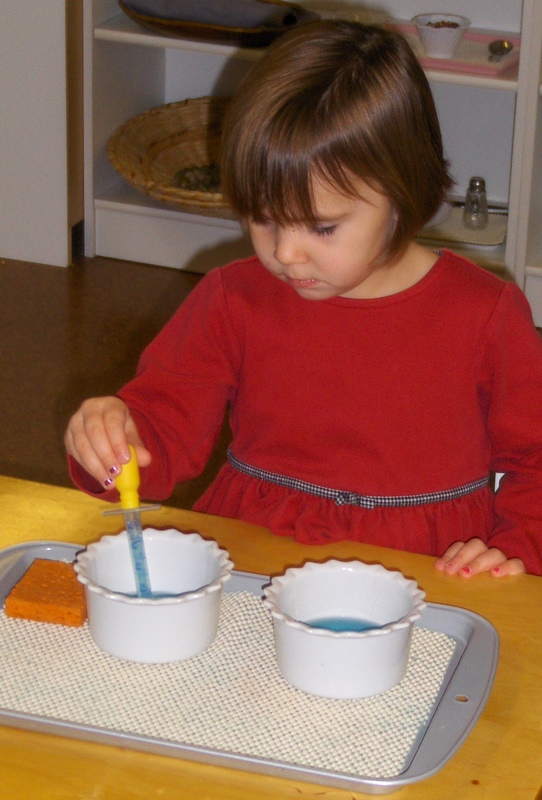
We have practical life activities in all of our atria, but by far the most can be found in the Good Shepherd Atrium (for 3-6 year olds).  Over the years, I have observed a strong connection between handwork and spirituality.  Pouring beans from one pitcher to another, moving water with an eye dropper, arranging flowers in a vase -- one only needs to observe a young child engaged in these activities to recognize the deep concentration, peacefulness and contentment that they can elicit.  Concentration, peace, and contentment are key attributes of prayer and meditation, and practical life builds up these attributes in the children better than anything else. As the child's capacity for concentration and joy in the presence of God grows, so does his or her ability to listen to presentations and mediate on the aspects of the Bible and the liturgy of the Church that we are offering in the atrium. 

In these first weeks, practical life will get quite a work out in our atria - and we catechists couldn't be happier!


For pictures of some of the practical life works featured on the blog this year, click here.

Tuesday, November 9, 2010

The Atrium Environment


In one of my first posts, I promised to write about the way that the atrium environment supports the independence of the children. The atrium is a prepared space – meaning that adults carefully put each room together according to the children’s needs. 
  • Everything in the space is scaled to the children who use it.  The furnishings and the materials were all chosen to allow them to be used successfully and independently by the children.  For example, the chairs in each atrium are always small enough for children to carry on their own, everything is within reach on the shelves, trays of materials are light enough to be carefully carried to tables etc.
  • We strive to have every part of every work ready and available for use in the atrium.  This way, children can use the materials freely without having to look for missing pieces or ask for adult help.  (I’ll admit it - this is the reason Catechists sometimes get grumpy when other people innocently rifle through the shelves!)
  • We have all the necessary cleaning supplies and replacement pieces available in the atrium, so that the children can clean spills and dirty items, replace used items, and always return the materials to the shelves ready for use by the next person.

All of these factors make it possible for children to follow their own interests and the promptings of the Holy Spirit during the two hour work period in the atrium, often with little help from the catechists. 

Check back soon to learn how the materials themselves meet the vital needs of the children…

    Thursday, September 30, 2010

    What is Practical Life?

    Last time, I promised pictures of some of the practical life exercises that are currently in the Good Shepherd Atrium.  Here they are!  To learn more about why practical life is important, check out yesterday's post, here.  Feel free to ask questions or make comments, by clicking on the word "comments" in the grey box at the end of the post!

    Some of our practical life exercises help develop small motor coordination, and teach skills which are "practical" for life!  Spooning, pouring, using the pincher grip, using scissors, and sorting are examples of this kind of work.  Here are some pictures!

    This is pouring!  We start by pouring larger dry items, and progress by stages to water and
    eventually (with one of the meditations on communion) to wine.

    This is tonging - using tongs to transfer an item from one bowl to another.  When setting up practical life we try to use the color of the Church year as much as possible.  This gives the children a visual clue to the liturgical season.  Many of our works are green right now, because green is the color of the Season after Pentecost!

    These baskets hold items the children transfer using their whole hand.  They love to examine and hold these beautiful nuts!


    With this work, the children transfer water from one bowl to the other with a sponge.  This is great preparation for cleaning up water spilled on a tray.

    Some of the practical life materials teach the children ways to care for the environment.  Wiping up spills, sweeping the floor, washing dishes, arranging flowers, polishing silver, and dusting are all examples of practical life which help children to be responsible for the atrium and allow them to function independently.  Because we use "real" materials in the atrium, such as glass dishes and child-sized utensils and tools, practical life enhances a child's respect for the environment and deepens their knowledge of how to care for the things around them.
    This is sweeping on a tray.  The children use the skills gained here frequently when they spill other practical life materials! :)
    This is a mirror polishing work.  The children in the Good Shepherd Atrium also learn to polish silver and brass.  They find this to be very relaxing work!

    The children enjoy dusting the shelves and other materials in the room. 

    Here you can see the carpet sweeper the children use to clean the carpets, and the broom and the white square on the tile used to learn to sweep the floor.

    This is just a peek at a few of the practical life materials we have on the shelves right now.  There are others, and the activities change regularly to keep the children's interest and appeal to their growing skill levels.

    Wednesday, September 29, 2010

    Why Practical Life?


    When we first began our atrium, I was skeptical about Montessori's Practical Life Exercises.  Don't get me wrong - I could see their value in a Montessori setting but I wasn't convinced that we needed them in the atrium.  We began with just a few basic activities, but I quickly discovered the spiritual dimensions of practical life, and now we can't get enough of it!  In fact, I first became interested in blogs as a way of hearing from some of the wonderful Montessorians on the web who write about their practical life exercises.  Setting up practical life, and changing it to meet the needs of the children as their skills develop over the year requires a good deal of observation and creativity, and I have come to enjoy it as much as the kids!

    We have practical life activities in all of our atria, but by far the most can be found in the Good Shepherd Atrium (for 3-6 year olds).  Over the years, I have observed a strong connection between handwork and spirituality.  Pouring beans from one pitcher to another, moving water with an eye dropper, arranging flowers in a vase -- one only needs to observe a young child engaged in these activities to recognize the deep concentration, peacefulness and contentment that they can elicit.  Concentration, peace, and contentment are key attributes of prayer and meditation, and practical life builds up these attributes in the children better than anything else. As the child's capacity for concentration and joy in the presence of God grows, so does his or her ability to listen to presentations and mediate on the aspects of the Bible and the liturgy of the Church that we are offering in the atrium.

    In these first weeks, practical life will get quite a work out in our atria - and we catechists couldn't be happier!

    Click here for another post on practical life with pictures of some of the work on our shelves!

    Thursday, September 23, 2010

    Everybody seems to know what to do...

    One of my favorite atrium memories happened in our first year.  The Bishop was visiting our Church and was planning to stop by and see our new atrium in action.  I was working in the 3-6 year old atrium at the time.  Just before I planned to slip out to get the Bishop, our other catechist received an emergency phone call and had to leave Church immediately. I was very suddenly alone with ten 3-6 year olds and I needed to leave the room!  (This is a safe-church nightmare, and one I didn't handle as well then as I hope I would now!).  Just then, I looked out of my door and saw a familiar face - the father of a child in our Nursery - passing by.  I quickly asked this gentleman into the room to supervise, so I could find another helper and meet the Bishop.  As I came up the stairs ten minutes later with the Bishop beside me, I felt sick at the thought of what might be happening in our atrium.  The scene that greeted us was something I'll never forget.  Ten little children contentedly working - some sitting at tables with materials in front of them, others moving quietly around the atrium returning materials to shelves and choosing something new.  And one full grown man sprawled across a tiny chair looking baffled.  "Everybody seems to know what to do," he said with a grin on his face.

    When the atrium is running smoothly, everybody does seem to know what do! This is no small feat, considering we spend two hours with the children each session, with most of the time set aside for the children to choose their own work, and work independently or in small groups. This is possible because of many factors but it really boils down to two:  a carefully prepared room and our preparation with the children.  I'll write more about the room later, but wanted to say a few things about our work with the children, which begins this Sunday at 9:15 am!

    At the start of the year, we spend time teaching the children the things they need to know to be independent in the atrium.  Here are a few first day presentations we show the children:

    • what do do when you arrive
    • how to carry a chair
    • how to unroll and re-roll a rug to work with materials on the floor
    • how to get the catechist's attention without interrupting
    • how to move quietly and speak quietly in the room
    • how to take a material off the shelf and return it ready for the next person to use

    This probably seems excessive, but it is with these lessons that we begin to create the culture of the atrium.  Understanding how to function in the room allows the children to move about freely and choose their own work to explore, as the Spirit moves them.  Knowing how to work independently with materials gives them time to meditate on what they are hearing, seeing, and doing.  With this kind of freedom, children don't have to be directed and entertained at every turn - instead real growth and discovery can happen in the quiet moments of reflection after the catechist and child have finished speaking. This also makes the catechist available to spend time with individual children or small groups - showing them new presentations or meditating with them on the work they have chosen.  Creating an atmosphere of quiet and reflection, where children can direct themselves and be directed by God is a big job for the catechists.  We begin this Sunday!  See you then!